
Next STEPS Literacy Course
Faculty across the country have built their literacy courses around a textbook written by Drs. Susan Smartt and Deb Glaser.
Now, Next STEPS Literacy Course gives them everything else: the structure, the lesson materials, the assessments, and the video demonstrations that bring it to life.
If you are looking for a course that is ready to teach and built to last, this is it.
Why teacher preparation needs to change


Most teachers graduate without the foundational literacy training they need to reach their most vulnerable students, and the children who pay the price are the ones who can least afford it.
For decades, teacher preparation programs taught one method: look at the picture and guess the unknown word. We now know that approach doesn't work, and we've known it for a long time. The research caught up years ago, but most pre-service teacher programs haven't.
The young students sitting in those classrooms are at-risk for reading failure, including kids showing early signs of dyslexia, English learners, and children who've never had consistent exposure to rich language at home. These kids can be taught to read with evidence-based instruction. We know what their brains need and how to provide it. The problem is that their teachers were never given those tools.
So school districts spend millions retrofitting through after-the-fact workshops and professional development, trying to build in what should have been there on day one. Teachers who arrive without the necessary knowledge of how to teach foundational reading skills burn out faster. Many leave the profession entirely.
Susan Smartt has been asking why this happens for 50 years. Next STEPS Literacy Course is her answer, built for the place where the problem starts.
The course is built around one idea:
assessment drives instruction.
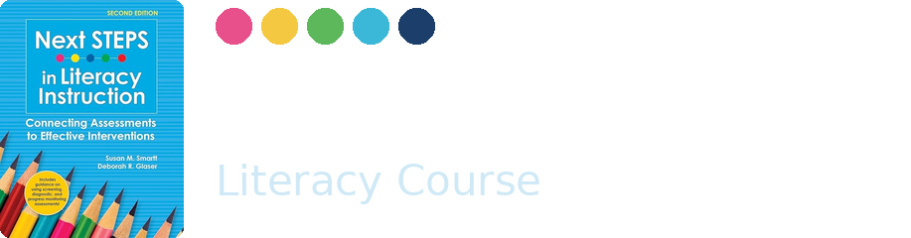
Next STEPS Literacy Course covers the full content of Susan's book (Next STEPS in Literacy Instruction, 2nd Edition, Smartt & Glaser, Brookes Publishing, 2024), organized to move faculty and their candidates from understanding to application.
Content areas include,
phonemic awareness, phonics, fluency, vocabulary, comprehension, and assessment,
each built around a single principle: knowing what your students need and adjusting when your instruction isn't working.

The course centers on an
outcomes-based framework.
Faculty and candidates learn how
to use screening data to form instructional groups and how to
use progress monitoring to
evaluate whether their teaching
is effective.
The assessment-to-instruction model
Decision trees and instructional road maps
Every content area includes
practical tools: decision trees,
planning frameworks, instructional routines and many practice activities
to ensure application in the
classroom. Faculty have concrete guides to build their syllabi around.


IDA-aligned from
the ground up
All course content aligns with the International Dyslexia Association's Knowledge and Practice Standards,
the recognized benchmark for structured literacy instruction in
higher education.
Faculty who adopt this course arrive
ready to teach.
Ready-to use teaching resources

Pre-written chapter objectives aligned to IDA standards.
Case studies and opening scenarios that frame each module. Chapter quizzes and assessment banks. Instructional slide decks faculty can take directly into their classrooms.
Everything they need to teach effectively is built in.
Video demonstrations
Faculty and candidates see skilled literacy instruction in practice: activities like Elkonin boxes, phoneme segmentation,
phoneme-grapheme mapping ,recognizing story structure and repeated reading techniques shown with real students.

Curated research and resources
Each module links to vetted external resources: foundational texts, current research, and multimedia that faculty can assign directly to candidates.

A community of learners
Participants join a network of faculty and pre-service teachers who share strategies, troubleshoot challenges, and stay current as the field evolves. The community is designed to follow candidates beyond the course, into student teaching, into their first classrooms, and beyond.

The research behind the course
Next STEPS in Literacy Instruction: Connecting Assessments to Effective Interventions
(Smartt & Glaser, 2024, Brookes Publishing) is adopted by literacy educator preparation programs across the country.

NCTQ
Exemplary
Rating
The National Council on Teacher Quality has evaluated Susan's work since 2008. Her books have consistently earned their top "exemplary" designation, meaning
an independent national organization has reviewed this content against
a detailed rubric and confirmed
it meets the highest standards
for teacher preparation.
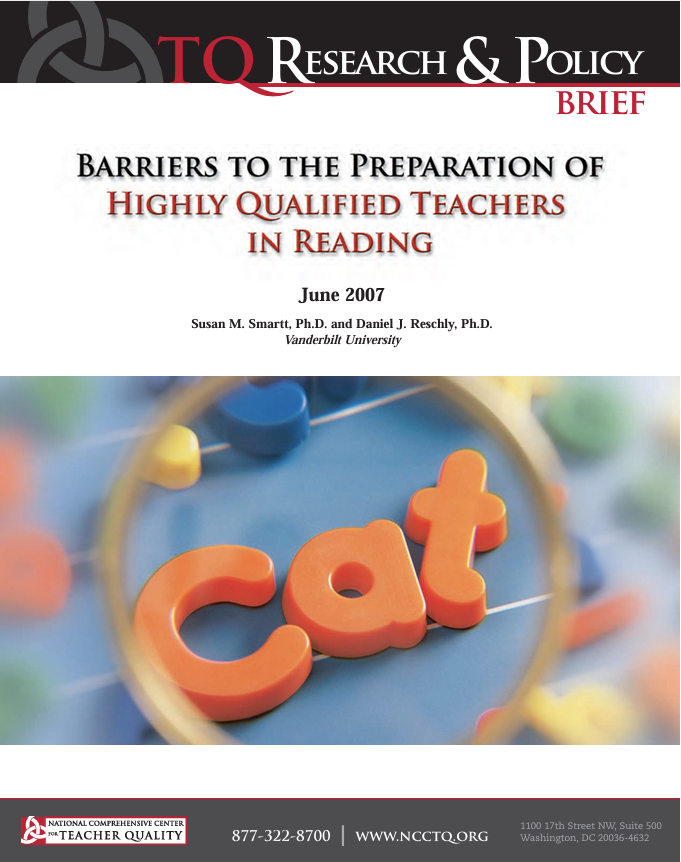
Susan's foundational policy brief, Barriers to the Preparation of Highly Qualified Teachers in Reading, was produced through the National Comprehensive Center for Teacher Quality with federal funding. She has been building the case for preservice
literacy reform for nearly 20 years
U.S. Department of Education-Funded Research
All course content aligns with the
IDA's Knowledge and Practice Standards, the field's gold standard
for structured literacy instruction. Susan has ongoing relationships
with the people who developed
those standards and helped shape
the crosswalk that connects
this course to them.
IDA
Knowledge and
Practice Standards

Dr. Susan M. Smartt
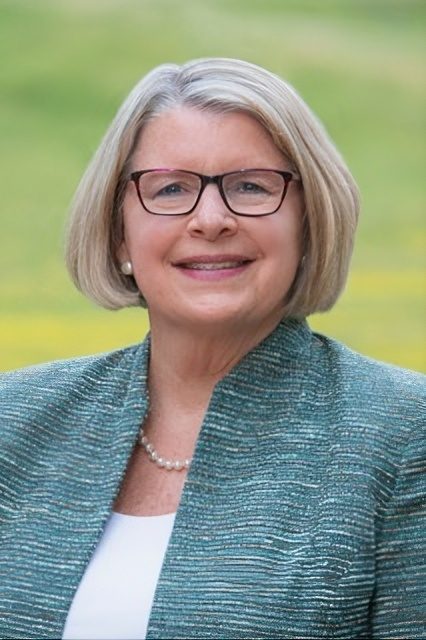
Susan Smartt has been asking the same question for 50 years:
why do so many children struggle to learn to read, and why aren't we stopping it before it starts or preventing reading failure?
It started in Tallahassee. She had 43 fifth graders, and five of them knew only five sight words. She was discouraged and overwhelmed— not with her students, but with her own training. Nobody had taught her what to do.
She started taking reading courses at FSU nights and in the summer, and she never really stopped learning.

Over the decades that followed, she opened and ran a reading clinic for more than 20 years. She conducted federally funded research at Vanderbilt. She traveled the country, training teachers in rooms of a hundred or more at a time, doing hands-on activities that show what good literacy instruction actually looks like in a classroom with real kids.
She worked as a national consultant to state departments of education and teacher preparation programs. She contributed to the early development of LETRS®. She served as the past president of the Tennessee Branch of the International Dyslexia Association.
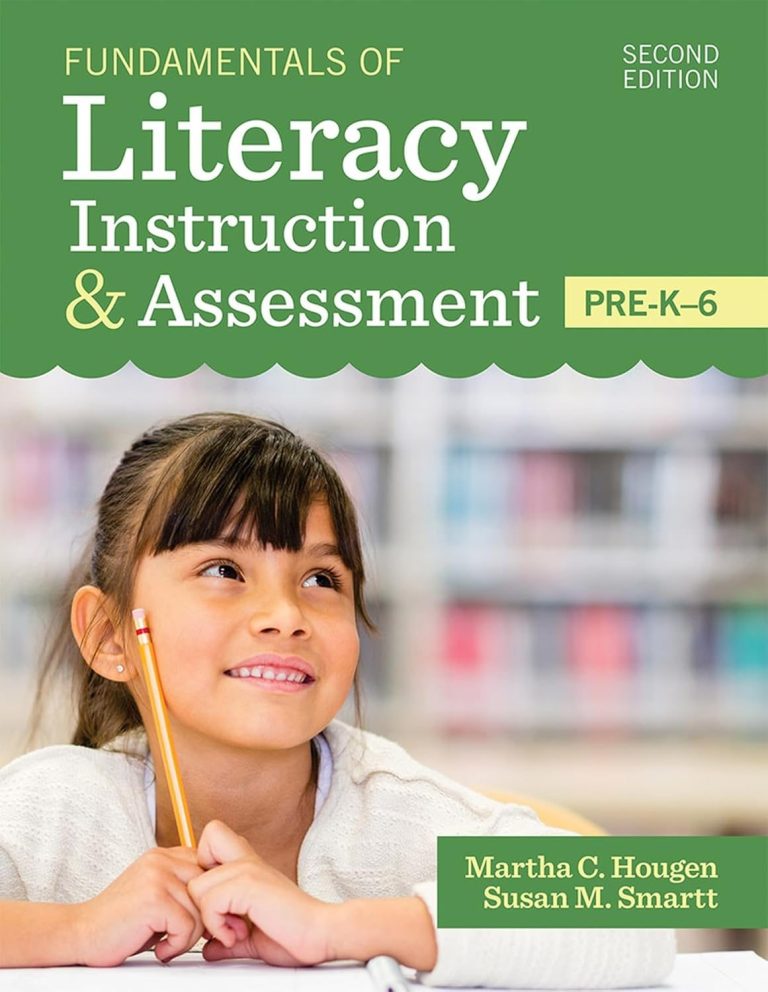
Her textbooks are used in university literacy programs nationwide.
She's a practitioner. Every part of her career has been hands-on: teaching beginning readers, working as a reading specialist, serving in a leadership role as a principal, testing kids, writing evaluation reports and making comprehensive recommendations for intervention, tutoring individuals and small groups, coaching teachers, conducting research on teacher quality, teaching preservice candidates, and providing professional development. That's what she brings to this course — not theory at a distance, but 50 years of knowing what works with struggling readers and what doesn't.
Her mission, in her own words: every child deserves a teacher who is prepared to teach them to read. If not me, who? If not now, when?
Next STEPS Literacy Course is how she intends to make it happen.
This course is ready for its first partners.
Next STEPS Literacy Course is currently in development and accepting its first institutional partners.